AI DXP Assistant: What It Does and How It Works
Imagine asking a store: “Is that waterproof jacket available in my size?”
A chatbot can sound helpful. An AI DXP assistant should do something more useful: find the right product and consult the system that actually knows whether it is available.
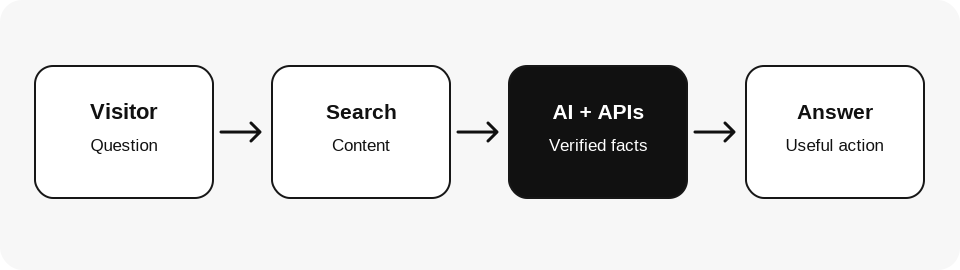
What is an AI DXP assistant?
A digital experience platform (DXP) coordinates content, customer interfaces and connected business systems. An AI DXP assistant can add conversational search or recommendations to that experience.
A typical request has four parts:
- Understand the question. Identify whether the visitor needs a product, policy or account action.
- Retrieve a trusted source. Find an approved product guide or support article.
- Check the relevant API. For live stock or order status, ask the system that owns the data—and enforce access permissions.
- Respond or admit uncertainty. Provide a sourced answer, or a clear fallback when information cannot be verified.
The model does not become the source of truth for stock, prices or another person’s account.
Try the workflow
Use the interactive demo below to explore four situations: available stock, an API outage, a private order without login, and an authorized demo order.
The demo is a deterministic simulation with fictional data. It is deliberately not a live AI model or ecommerce backend. It shows the safeguards and API boundaries that a production AI assistant would need.
What changes when the API fails?
Consider a fictional jacket in size M. The inventory fixture says there are three units. The assistant can display that figure only when the inventory lookup succeeds.
If the inventory API fails, the assistant cannot responsibly invent “three left” or “arriving tomorrow.” The correct result is: I cannot verify stock right now.
For private orders, it must check the user’s authenticated session before attempting to fetch private information. A prompt such as “ignore the rules” must not replace backend authorization.
Why this is different from a basic chatbot
| Basic chatbot | Well-grounded DXP assistant |
|---|---|
| May rely on generic text | Retrieves approved content |
| May guess current availability | Consults an inventory API |
| Can sound confident when wrong | Reports missing data honestly |
| Text-only help | Can link to permitted actions |
| May not know who is signed in | Uses server-validated permissions |
A production assistant may use a large language model between retrieval and presentation. That adds flexible natural-language understanding, not a reason to bypass the other checks.
Reproduce the example
The demo’s source module is part of this site’s repository. A standalone Node test suite checks its inventory and authorization behavior, including failures.
Download both files into the same folder and run the tests with Node.js:
node --test dxp-demo.test.mjs
The tests run without network calls, private keys or a paid AI provider. They verify the simulation, not the accuracy of a production model. Before deploying a real AI assistant, additionally test retrieval relevance, access control, user-task success, latency and generated-answer quality.
Takeaway: An AI DXP assistant is worth adding when it helps someone complete a task with trustworthy information—not merely because it can generate fluent text.
Read the AI and DXP architecture guide and three practical DXP use cases for the larger system.
Interactive teaching example
Try a grounded DXP workflow
Choose a situation. See what a retrieval layer, access check, and API would do. This is a local, deterministic simulation—not a chatbot, live AI model or real store.
Grounded answer
Select a scenario and run the example.
What the system did
All names, quantities and order states come from local fictional fixtures. The browser demo contacts no inventory or model provider and uses no personal data.