What is a DXP (Digital Experience Platform)?
A digital experience platform (DXP) is a set of software capabilities used to create, manage, deliver, and improve experiences across websites, mobile apps, commerce, and customer portals. A DXP connects content management with data, analytics, integrations, and often personalization. It can be one integrated suite or a composable collection of services.
A CMS primarily organizes and publishes content; a DXP coordinates more of the experience around that content. Read our DXP vs CMS comparison.
What does AI add to a DXP?
- Search and discovery: Understand the meaning behind questions and help visitors find relevant content.
- Recommendations: Suggest products, articles, or next steps based on available context.
- Content operations: Assist editors with drafting, tagging, translation, and content reuse.
- Analytics: Find patterns in usage data to help teams test and improve experiences.
AI is an additional capability, not a substitute for reliable source content, customer consent, human review, or data governance.
How does an AI-powered DXP work?
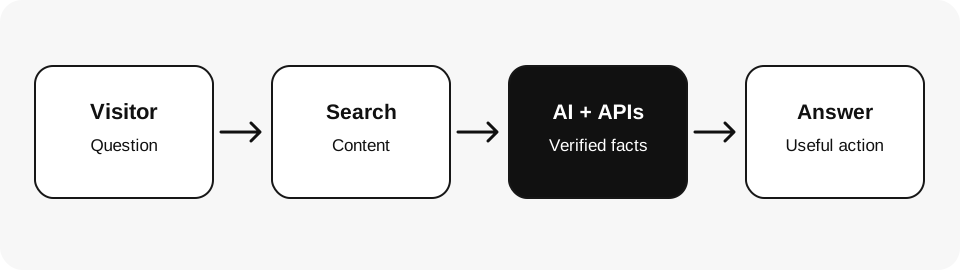
- Connect content and systems. A DXP brings together approved content, commerce, analytics, and customer-facing applications through integrations or APIs.
- Understand the visitor's context. With appropriate permissions, the platform may use a search query, session behavior, or customer preferences to understand what is relevant.
- Apply AI where useful. Search, ranking, recommendation, or generative models help choose or prepare a response.
- Deliver the experience. The website, app, or portal displays content or an action suited to the visitor and channel.
- Measure and improve. Teams evaluate quality, relevance, accessibility, and outcomes, then adjust content, rules, and models.
AI-driven DXP vs AI-powered DXP
Both terms describe adding AI capabilities to digital experience platforms. AI-driven often emphasizes AI-supported decisions or recommendations, while AI-powered emphasizes features such as semantic search, automated tagging, and content assistance. Neither term guarantees a particular technical architecture. Read the AI and DXP integration guide for implementation details.
AI DXP example: an online store
A shopper searches for a lightweight travel bag. Instead of matching only the exact words, an AI-assisted search system can interpret the request and surface relevant products. The DXP can combine the product catalog, availability, and approved customer preferences to display useful options consistently across the store and its app. This is an illustrative workflow, not a claim about a particular vendor or a guaranteed conversion improvement.
Frequently asked questions
Is AI DXP a single product?
No. Here, AI DXP describes the use of artificial intelligence within digital experience platforms. Vendors implement these capabilities in different ways.
Is a DXP the same as a CMS?
No. A CMS focuses on managing content. A DXP extends the scope to connected experiences, often including personalization, analytics, and multiple channels.
What is an AI DXP assistant?
An AI DXP assistant is a conversational interface that helps people navigate a digital experience, search approved information, or complete permitted tasks through connected APIs. It needs reliable sources, access controls, and a way to escalate when it cannot help. Try the interactive example and see the checks.
Does every DXP require AI?
No. AI features are optional and depend on business needs, platform capabilities, data quality, and governance requirements.